Bilge & sumps
Cuts through heavy fuel residue, lube oil and biofilm in engine room bilges. Safe on steel.
A yeast-powered concentrate engineered for ship bilges, ballast and bunker tanks, hold cleaning and shipyard work. Biodegradable. Tough on heavy fuel residue.
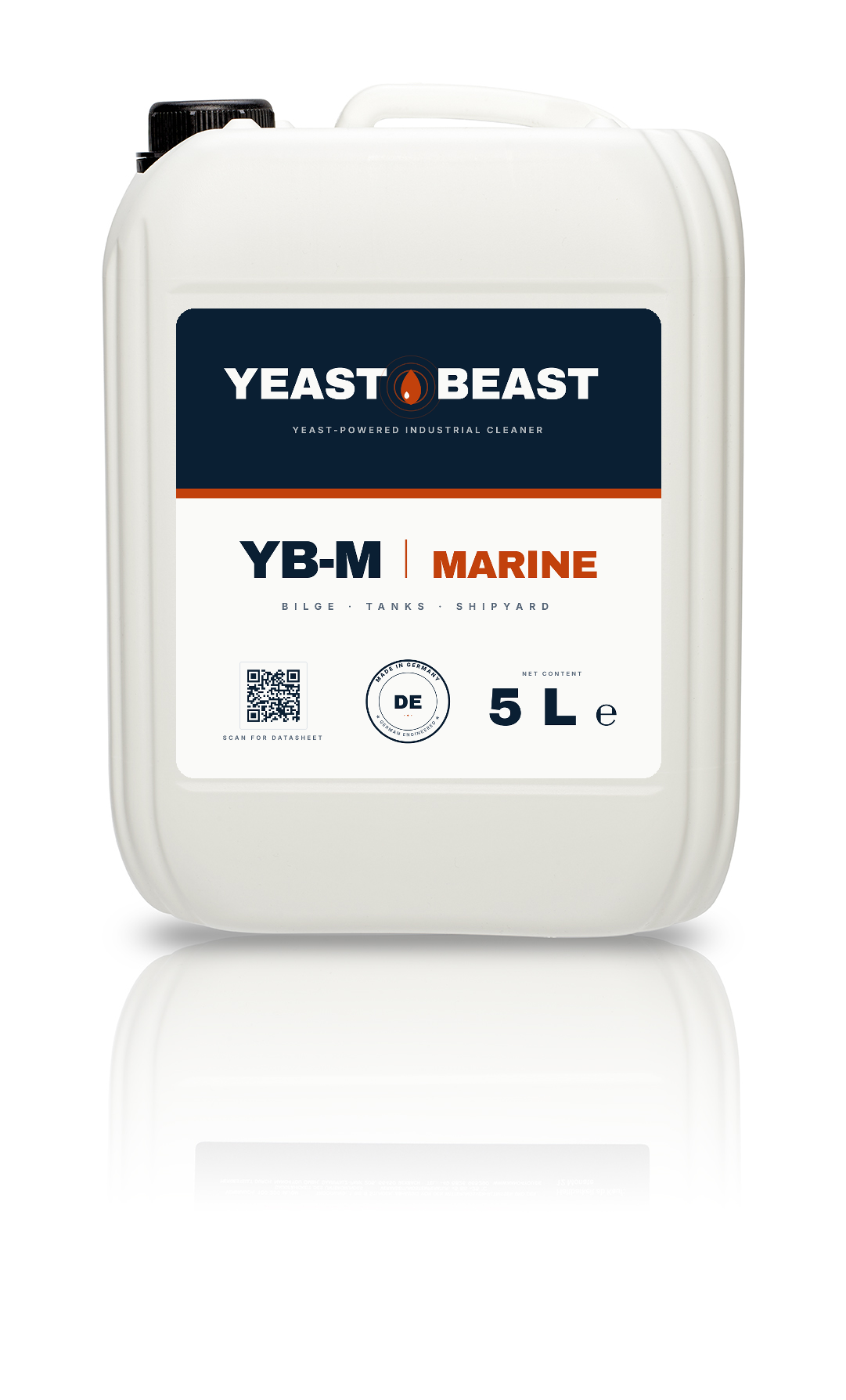
Cuts through heavy fuel residue, lube oil and biofilm in engine room bilges. Safe on steel.
Ballast, fuel, heavy-fuel, fresh water and wastewater tanks. Reduces gas-freeing time.
Bulk carrier holds between cargo changes. Removes grain, soot, vegetable oil and protein residue.
Pre-treatment before coating, surface preparation, dock-stay cleaning under tight turnaround.
Breaks down HFO sludge and varnish in bunker tanks. Works at 40 to 60 °C.
Two-stage treatment with optional antimicrobial follow-up for full odor neutralization.
Note. Neat concentrate not for aluminium, zinc or other amphoteric light metals. At working dilution (1:10 and weaker), aluminium and zinc are safe in practice. Spot test recommended on coated surfaces.
The neat concentrate (pH 10.5 to 11.5) is not compatible with aluminium, zinc or other amphoteric light metals. Above pH 8.5 these metals start to react.
At working dilution (1:10 and weaker), aluminium and zinc are safe in practice. Real-world impact at short contact times is minor and Yeast Beast Marine is routinely used in mixed-metal engine rooms at recommended dilutions. We still recommend a 24-hour spot test on polished or highly visible aluminium surfaces before scaling up.
Standard bilge cleaning works well at 1:10 to 1:20 with the surface pre-wetted. For heavy fuel oil residue or older deposits, drop to 1:5 to 1:10, apply at 40 to 60 °C and let it soak 15 to 30 minutes before high-pressure rinse.
For routine maintenance between dock stays, 1:30 to 1:60 is sufficient.
In practice yes, because the biological cleaning chemistry breaks down hydrocarbon residue faster and more completely than caustic cleaners alone. We have seen turnaround reductions of 20 to 35 percent on bunker tanks, depending on the previous cargo and tank geometry.
We do not publish this as a guaranteed metric. Run a controlled comparison on one tank before scaling to the full fleet.
Yes for most modern epoxy and zinc-silicate coatings. However, always run a 24-hour spot test on a hidden area before full-tank application, especially on coatings older than five years.
For unknown or proprietary coatings, request the coating manufacturer compatibility statement first.
The active matrix is biologically biodegradable. After use, the spent cleaning solution will be loaded with the soiling it removed (HFO, lube oil, biofilm), so it must be disposed of per local waste-water regulations, typically as oily wastewater for a licensed processor.
The product itself is not classified as hazardous waste in its clean concentrate form.
From our warehouse in Bexbach, Germany:
For urgent dock-stay deliveries we can arrange expedited transport at cost.
Sample: free, size depending on the application (typically 1 to 5 litres), shipping at cost (typically 7.50 EUR within Germany, more for international).
Trial order: 20 liters or 200 liters.
Standard production order: 1,000 L IBC for direct customer or distributor pricing.
We are looking for distributors in major maritime hubs (Hamburg, Rotterdam, Piraeus, Singapore, Houston, Dubai). If you supply shipyards, tank cleaners or port-services, we want to hear from you.
Send us your typical soiling profile and dock-window length. We will recommend the right dilution and ship a sample.